
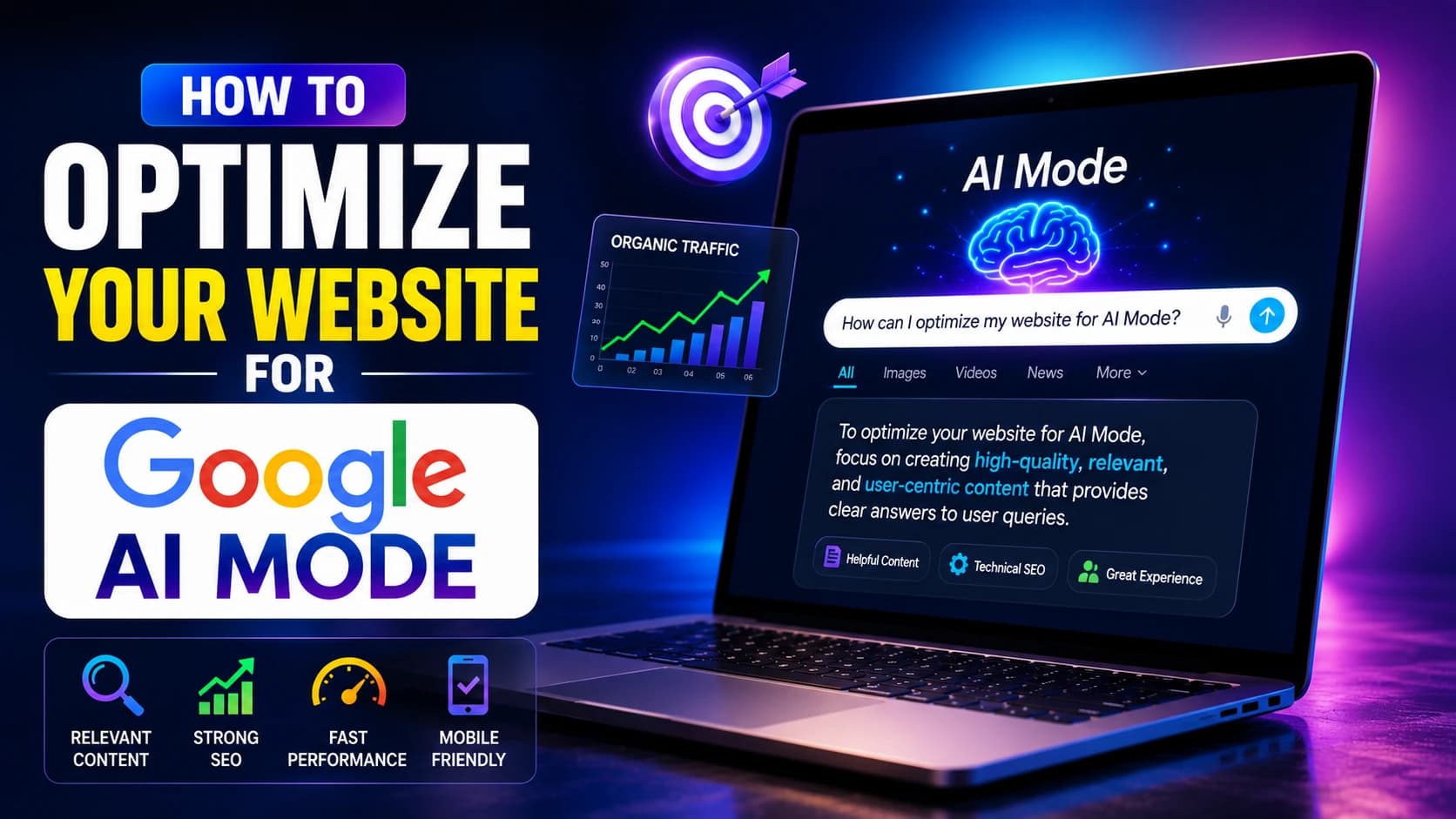
Google Search is changing faster than ever. Instead of showing only a list of blue links, Google AI Mode understands questions, analyzes multiple sources, and generates detailed answers directly on the search results page. This means users often get their answers without opening several websites.
For businesses, this creates a new challenge. Ranking on page one is no longer enough. Your website must become a trusted source that Google’s AI can understand, reference, and recommend.
If your traffic has dropped or your content isn’t appearing in AI-generated responses, the problem may not be your rankings. It may be that your website isn’t optimized for Google’s AI-powered search experience.
Table of Contents
Understand How Google AI Mode Chooses Content
Google AI Mode doesn’t simply rank pages by keywords. It evaluates whether your content provides complete, accurate, and trustworthy information.
The AI looks for:
- Clear answers to user questions
- Topical expertise
- Fresh and updated information
- Reliable sources
- Strong website authority
- Structured content that is easy to understand
Instead of optimizing for a single keyword, focus on solving the user’s complete problem.
Build Topical Authority Instead of Publishing Random Blogs
Many websites create isolated articles targeting individual keywords. Google AI prefers websites that cover an entire topic in depth.
For example, if your business offers SEO services, don’t stop at publishing one article about AI SEO. Build a complete content hub covering topics such as AI Mode, AI Overviews, semantic SEO, structured data, entity SEO, search intent, EEAT, technical SEO, and content optimization.
When your articles are connected through internal links, Google understands that your website has genuine expertise in the subject.
Write Content That Answers Real User Questions
AI Mode is designed for conversational searches.
Instead of writing content only around keywords like:
“Google AI Mode SEO”
Create sections that answer questions users actually ask, such as:
- What is Google AI Mode?
- How does Google AI Mode work?
- Why is my website not appearing in AI results?
- How can I optimize my website for AI-powered search?
- Does structured data improve AI visibility?
When your content directly answers these questions, Google can easily extract and reference your information.
Improve Entity SEO
Google no longer relies only on keywords. It understands relationships between people, businesses, products, locations, and concepts through entities.
To strengthen entity SEO:
- Maintain consistent business information across your website and business profiles.
- Mention relevant industry terms naturally.
- Use Organization, Article, FAQ, and Breadcrumb schema.
- Link related pages together using descriptive anchor text.
- Build mentions of your brand on trusted websites.
The stronger your website’s entity signals, the easier it becomes for Google AI to understand your expertise.
Focus on Semantic SEO Instead of Keyword Stuffing
Modern SEO is about covering a topic completely rather than repeating the same keyword.
For example, a page targeting Google AI Mode should naturally include related concepts like:
- AI-powered search
- AI Overviews
- Search intent
- Large Language Models (LLMs)
- Structured data
- Topical authority
- EEAT
- Content optimization
- User experience
This helps Google understand the complete context of your content.
Optimize Technical SEO for AI Crawling
Even great content won’t perform well if search engines struggle to crawl your website.
Make sure your website has:
- Fast loading speed
- Mobile-friendly design
- Clean URL structure
- XML sitemap
- Proper robots.txt configuration
- HTTPS security
- Core Web Vitals optimization
- Internal linking between related pages
Technical SEO provides the foundation that allows Google’s AI systems to access and interpret your content efficiently.
Add Structured Data Wherever Possible
Structured data gives Google additional context about your pages.
Depending on your content, implement relevant schema types such as:
- Article
- FAQ
- Organization
- Service
- Product
- Breadcrumb
- Local Business
While schema doesn’t guarantee AI visibility, it makes your content easier for Google to understand and categorize.
Keep Content Updated with Fresh Information
Google AI prefers current, relevant information over outdated advice.
Review important pages regularly to:
- Update statistics
- Add recent examples
- Improve explanations
- Answer newly emerging questions
- Refresh screenshots and visuals
A consistently updated website signals reliability and improves long-term search performance.
Conclusion
Google AI Mode is changing the way people discover information online. Businesses that continue relying only on traditional keyword-focused SEO may find it increasingly difficult to maintain visibility.
The websites that succeed are those that demonstrate expertise, answer user questions comprehensively, build topical authority, and provide content that is easy for Google’s AI to understand. By combining semantic SEO, entity optimization, technical improvements, structured data, and high-quality content, you can improve your chances of appearing in AI-powered search experiences while also strengthening your organic rankings.
The goal is no longer just to rank for keywords. The goal is to become the most trusted source that Google AI chooses to recommend.