
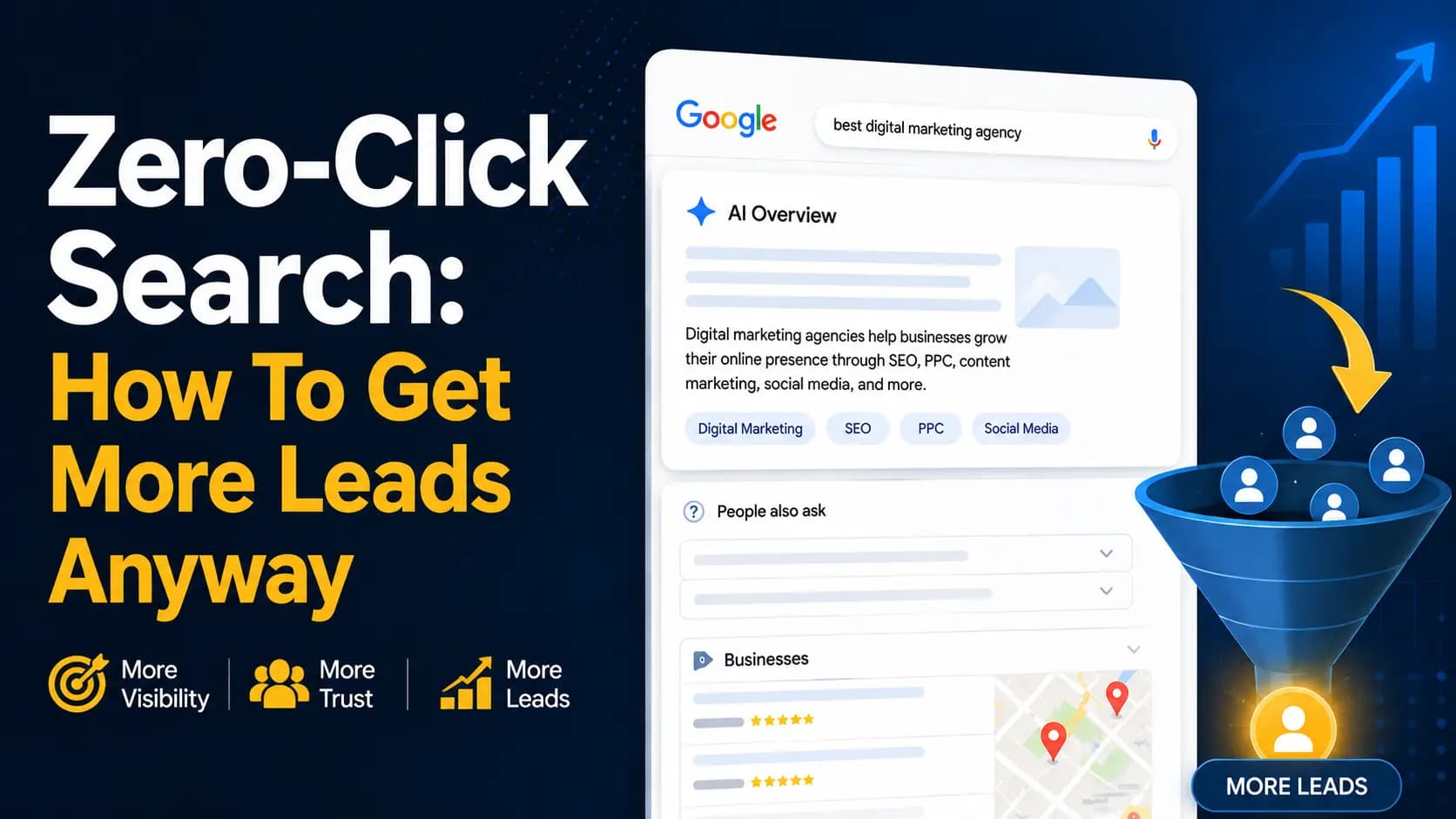
Ranking on Google used to follow a simple path: rank → get the click → convert the visitor into Leads.
That path is changing.
Searchers can now get answers directly from AI Overviews, featured snippets, Google Business Profiles, knowledge panels, People Also Ask results, maps, videos, and other SERP features. In the first four months of 2026, 68.01% of Google searches ended without a click, according to SparkToro research using Similarweb clickstream data.
This is zero-click search. But fewer clicks do not automatically mean fewer business opportunities.
The smarter SEO goal is no longer just “get more website traffic.” It is to make your brand visible, trusted, and easy to contact wherever the customer is searching.
Table of Contents
What Is Zero-Click Search?
A zero-click search happens when someone searches on Google but does not click through to a website.
For example, someone searching “best website development company near me” may see local businesses, ratings, phone numbers, directions, reviews, and service information directly on Google. They may call a company without visiting its website.
Similarly, someone asking “How much does website development cost?” could receive an AI-generated summary before reaching traditional organic results.
AI Overviews make this behaviour even more important. Pew Research found that users clicked a traditional result in 8% of visits when an AI summary appeared, compared with 15% when one did not. Links inside the AI summaries themselves received clicks in only about 1% of visits.
So how do you generate leads when people increasingly get their answers before reaching your website?
Optimize for Visibility, Not Just Rankings
A #1 organic position is valuable, but it should not be your only target.
Your business can potentially appear across:
- AI Overviews and AI Mode
- Featured snippets
- Local Pack and Google Maps
- People Also Ask
- Image and video results
- Branded searches
- Traditional organic listings
Think of modern SEO as SERP visibility rather than ten blue links.
For a local business, for example, a well-optimized Google Business Profile with accurate services, reviews, photos, categories, and contact details can influence a customer before a website visit ever happens.
Build Content That AI Can Understand and Cite
Google says there are no special technical requirements for appearing in AI Overviews or AI Mode beyond being indexed, eligible for Search, and following its existing SEO guidance. Google continues to recommend helpful, reliable, people-first content.
That means chasing tricks for “AI SEO” is not the answer.
Instead, make pages easier to understand.
Start important sections with direct answers. Follow them with supporting details, examples, comparisons, evidence, and practical advice.
For example:
How much does SEO cost in Mumbai?
Instead of writing 300 words before answering, give the reader useful context immediately. Then explain what changes the price, what services are normally included, and what businesses should compare before hiring an agency.
This structure works for humans and makes individual passages easier for search systems to interpret.
Strengthen Your Brand as an Entity
Search engines increasingly need to understand who is behind the information, not only which keywords appear on the page.
Keep your business name, services, location, contact information, author details, and organization information consistent across your website and relevant external profiles.
Support this with appropriate structured data such as:
Organization, LocalBusiness, Service, Product, Article, Breadcrumb, and other relevant schema types.
But the schema should describe what genuinely exists on the page. It is not a shortcut to AI visibility.
Build supporting signals through credible mentions, industry directories, PR, reviews, partnerships, social profiles, and useful original content.
The goal is to create a clear digital footprint around your business.
Target High-Intent Searches That Still Need Action
Not every keyword has equal lead value.
A query like “what is SEO?” can easily be answered without a click.
But searches such as:
“SEO company in Mumbai,” “SEO audit services,” “SEO agency for ecommerce,” or “hire local SEO experts” suggest that the user needs a provider, not just information.
Create content across the full customer journey, but connect informational pages naturally to commercial pages.
A blog explaining local SEO, for example, should guide qualified readers toward a relevant local SEO service rather than leaving them at a dead end.
Use the Zero-Click Lead Framework
A simple framework to follow is:
Answer → Prove → Differentiate → Convert
Answer: Give a clear response to the search intent.
Prove: Support it with examples, experience, data, case studies, screenshots, or original insights.
Differentiate: Explain something competitors have missed rather than rewriting the same information already ranking.
Convert: Give the reader an obvious next step such as requesting an audit, calling, booking a consultation, checking pricing, or sending an enquiry.
This turns SEO content from a traffic generator into a customer acquisition asset.
Measure Leads, Not Traffic Alone
Organic sessions are still useful, but traffic should not be your only SEO KPI.
Track qualified enquiries, phone calls, form submissions, booked appointments, branded searches, Google Business Profile actions, assisted conversions, and revenue from organic search.
A page attracting 300 visitors and producing 15 enquiries can be more valuable than one attracting 5,000 visitors and generating none.
Zero-click search makes that distinction even more important.
Zero-Click SEO Is About Owning the Answer
Search is moving from a click economy toward an answer economy.
Google itself says established SEO fundamentals remain relevant as generative search develops, while also emphasizing unique, valuable content for AI-powered Search experiences.
Businesses therefore should not abandon SEO because clicks are becoming harder to win.
The strategy needs to change.
Build topical authority. Strengthen your brand entity. Answer questions clearly. Target commercial intent. Improve local visibility. Give Google and users strong evidence of why your business should be trusted.
The goal is simple: even when users do not click immediately, make sure your brand is the one they remember when they are ready to act.